
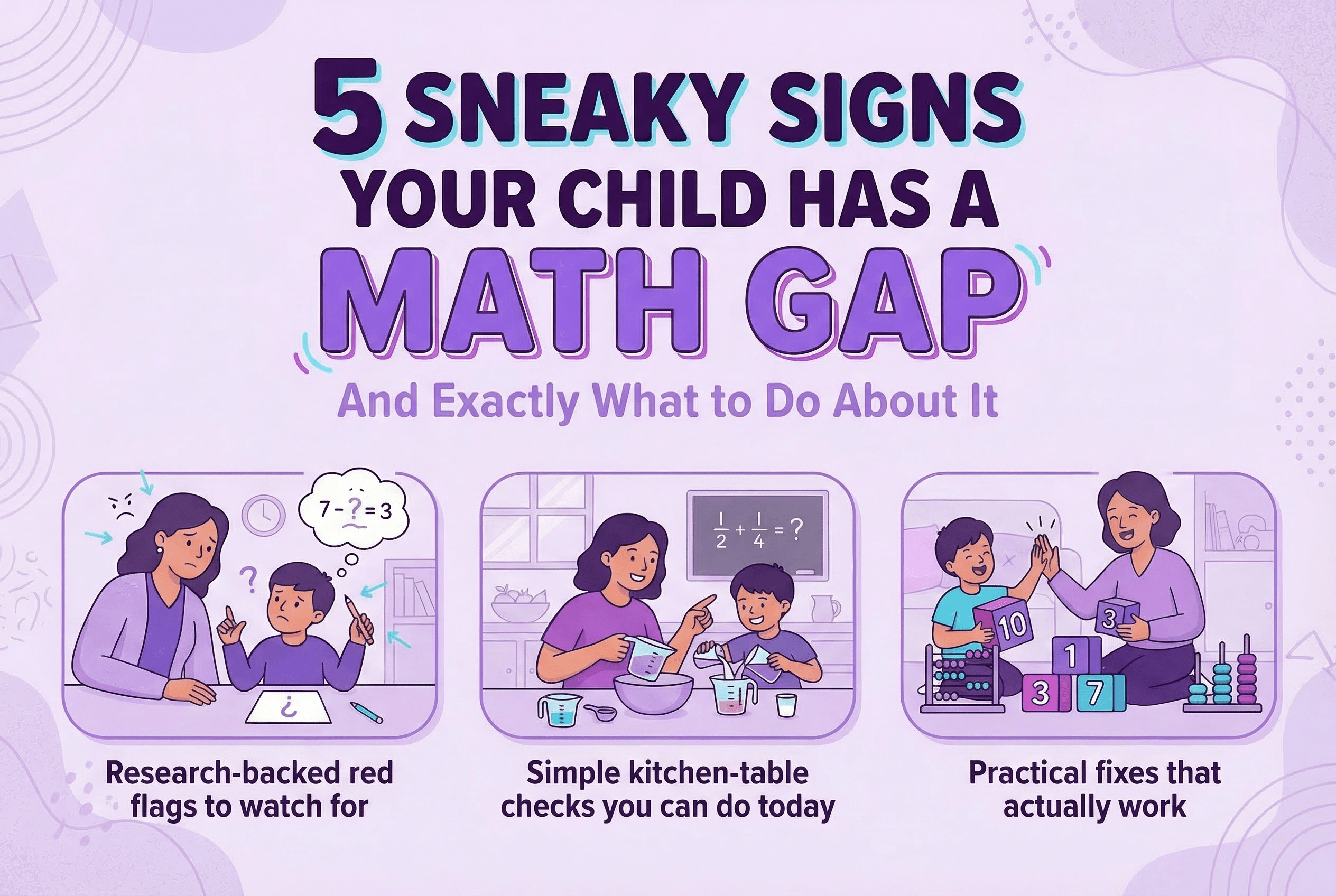
5 Sneaky Signs Your Child Has a Math Gap (and Exactly What to Do About It)
Most Kids Have a Math Gap!
If math time feels harder than it “should,” you're not imagining it. A math gap is usually just a missing prerequisite skill (often tiny!) that makes everything downstream feel wobbly. And the numbers show just how widespread this really is:
Only 39% of 4th-graders scored at or above NAEP Proficient in math.1
Only 28% of 8th-graders scored at or above NAEP Proficient in math.1
So if your child is struggling, you're not alone, and it's not a character flaw. It's usually a “missing step” problem. Here's how to spot it.
Before the 5 Signs... How Do I Find All the Gaps?
Finding gaps is hard!!
Once you suspect a math gap, figuring out where it actually is can feel like detective work. Parents end up:
- Reading blog posts and curriculum guides
- Testing individual skills one by one
- Trying to trace problems back through earlier grades
After trying everything with my son, the best tool I've found is Astral: an AI math tutor that finds every gap and fixes them. Here's a link that gets you two weeks for free, no credit card involved.
Full transparency: I love it so much that I work there now! So yes, I am biased, and I also really believe in it.
Now let's look at the 5 signs a math gap might be hiding!
The 5 Signs to Watch For
Number Sense Feels “Squishy”
They can “do math,” but misjudge which number is larger (48 vs. 84), rely on counting for everything, or seem unsure about what numbers actually mean.
Ask: “Which is closer to 100: 62 or 89?” If this is consistently hard, a number-sense gap may be underneath.
Early number competence strongly predicts later math achievement in longitudinal research.3
Math Facts Won't Stick, Even After “Lots of Practice”
They still count on fingers for basic facts, freeze on simple sums, or take forever because nothing is automatic.
Over 2–3 days, ask the same 10 single-digit facts (mixed addition and subtraction). If accuracy is inconsistent or painfully slow each time, you're likely looking at a retrieval/fluency gap.
Difficulty learning and retrieving arithmetic facts is a consistently observed issue in children with math difficulties.4
Place Value Errors Are Popping Up Everywhere
Mixing up 302 vs. 320, lining up digits wrong, “mystery” subtraction mistakes, confusion with regrouping, decimals, or zeros.
Have them build 154 with base-ten blocks (or quick sketches): 1 hundred, 5 tens, 4 ones. Then ask them to show 145 and explain the difference.
Place-value understanding is a reliable predictor for later arithmetic performance.5
Multi-Step Problems Fall Apart (They Lose the Thread, Not the Math)
They can do each skill in isolation, but multi-step word problems feel impossible: lots of erasing, guessing, or skipping steps.
Read a word problem aloud and ask: “What's the story type: are we combining, comparing, or changing?” If they can't identify the structure, the gap might be problem representation, not computation.
A major evidence-based recommendation is to teach word-problem solving using common underlying structures (not just keywords).7
Big Emotions or Avoidance Show Up Specifically During Math
Sudden tears, stomach-aches, “I'm just bad at math,” rushing, refusal... especially with timed or unfamiliar tasks.
Ask them to rate their math worry on a 0–10 scale before you start. If it's regularly high, treat the emotional piece as real data.
A large meta-analysis found a consistent negative association between math anxiety and math achievement (overall correlation around −0.28).6
So now what?
Kitchen-table checks are a great start, but they can't catch everything. This is why I highly recommend Astral: an AI math tutor that assesses gaps and fixes them. If you'd like to try it out, click here to try it free for two weeks, no credit card required.
But even if you're just working through things together at the kitchen table, here are a few research-backed ways to help close math gaps at home.
4 Evidence-Backed Fixes You Can Actually Do at Home
Use visual models on purpose (number lines, arrays, base-ten drawings). Visual representations are a core recommendation in evidence-based math interventions.7
Practice “a little, often” and MIX problem types (not 30 of the same). Interleaved practice improves math learning compared with blocked practice in controlled research.8
Play linear number board games (think 0–100 “number line” style). Research shows these games can improve numerical magnitude understanding and related early math skills.9
If you add tutoring, aim for consistency. A major meta-analysis found tutoring programs produce meaningful average achievement gains (overall effect size ~0.37 SD), with effects varying by program design.10
References
National Assessment & Proficiency Data
- [1]NAEP (2024). Explore Results for the 2024 NAEP Mathematics Assessment. https://nces.ed.gov/nationsreportcard/mathematics/
- [2]NCES (2026). Scale Scores and NAEP Achievement Levels. https://nces.ed.gov/nationsreportcard/guides/scores_achlevels.aspx
Signs and Why They Matter
- [3]Jordan, N. C., et al. (2009). Early math matters: Kindergarten number competence and later mathematics achievement. Developmental Psychology, 45(3), 850–867. https://doi.org/10.1037/a0014939
- [4]Geary, D. C. (2011). Consequences, characteristics, and causes of mathematical learning disabilities and persistent low achievement. Journal of Developmental & Behavioral Pediatrics, 32(3), 250–263. https://doi.org/10.1097/DBP.0b013e318209edef
- [5]Moeller, K., et al. (2011). Early place-value understanding as a precursor for later arithmetic performance — A follow-up. Research in Developmental Disabilities, 32(5), 1837–1851. https://doi.org/10.1016/j.ridd.2011.03.014
- [6]Barroso, C., et al. (2020). A meta-analysis of the relation between math anxiety and math achievement. Psychological Bulletin, 147(2), 134–168. https://doi.org/10.1037/bul0000307
Interventions Parents Can Adapt at Home
- [7]Institute of Education Sciences / WWC (2021). Assisting Students Struggling with Mathematics: Intervention in the Elementary Grades (Practice Guide). https://ies.ed.gov/ncee/wwc/PracticeGuide/26
- [8]Rohrer, D., et al. (2015). Interleaved practice improves mathematics learning. Journal of Educational Psychology, 107(3), 900–908. https://doi.org/10.1037/edu0000001
- [9]Siegler, R. S., & Ramani, G. B. (2008). Playing linear numerical board games promotes low-income children’s numerical development. Developmental Science, 11(5), 655–661. https://doi.org/10.1111/j.1467-7687.2008.00714.x
- [10]Nickow, A., Oreopoulos, P., & Quan, V. (2020). The impressive effects of tutoring on PreK–12 learning: A systematic review and meta-analysis. NBER Working Paper No. 27476. https://doi.org/10.3386/w27476